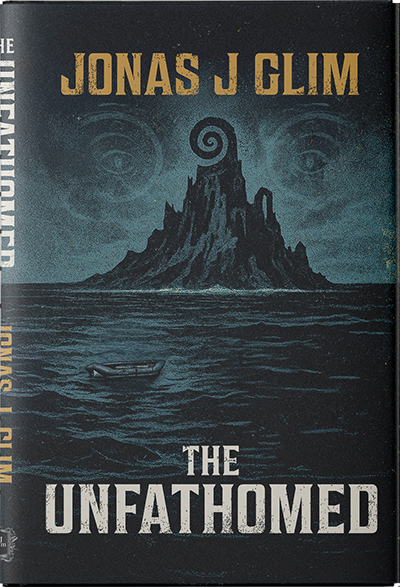
The Cosmic Question
The seed of The Unfathomed began during one of those sleepless nights, absorbing lectures on exotic physics and quantum mechanics. I was struck by how certain our cats seem about the world around them—this intellectual optimism that most mammals display, as if they understand how things work and what's important.
But humans? We've convinced ourselves we understand reality while knowing embarrassingly little about the largest inhabitable volume of our own planet—the ocean. That hubris fascinated me. What if we're like those confident cats, completely unaware of how limited our perception truly is?
"Cosmic horror as a genre reminds us that the greatest revelation about absolute truth might forever remain, for all intents and purposes, truly unfathomable."
The island, the ancient markings, the fractured realities—they all emerged from this central question: What happens when human certainty collides with incomprehensible truth?
Writing in the Dark Hours
My writing process is shaped by anxiety-induced insomnia—those pre-dawn hours when truth hits hardest. I'd find myself absorbing lectures on exotic physics, theories about consciousness, and the strange mathematics that govern reality at its edges.
This nocturnal education directly informed Peter's journey. His fractured memories, his competing realities—these weren't just horror tropes but attempts to capture what it might feel like when human consciousness encounters something genuinely beyond comprehension.
The Technical Foundation
Twenty years in software engineering taught me that complex systems often behave in unpredictable ways. Small changes can cascade into complete system failures. I applied this thinking to reality itself—what if consciousness, like code, could be hacked? What if memory, like data, could be corrupted or rewritten?
Beyond the Horror
While The Unfathomed is cosmic horror, it's equally concerned with very human questions: How do we love someone when we're not sure who we are? How do relationships survive when reality itself becomes unreliable?
Peter and Dana's failing relationship mirrors the larger cosmic uncertainty. Just as they struggle to understand each other, humanity struggles to understand its place in an indifferent universe.
The Loops We Live In
The temporal loops in the story reflect the patterns we get stuck in—emotionally, psychologically, relationally. Sometimes we need reality itself to fracture before we can break free from the cycles that trap us.
"Maybe what is true or false doesn't matter outside of shared agreements of what is up and what is down. Maybe we have lost some key insight, having been led astray by technological modernism."